Market insights
CinemaCon 2026: Moviegoing Is Here To Stay – But Not Without Cultural IQ
April 23, 2026
April 23, 2026
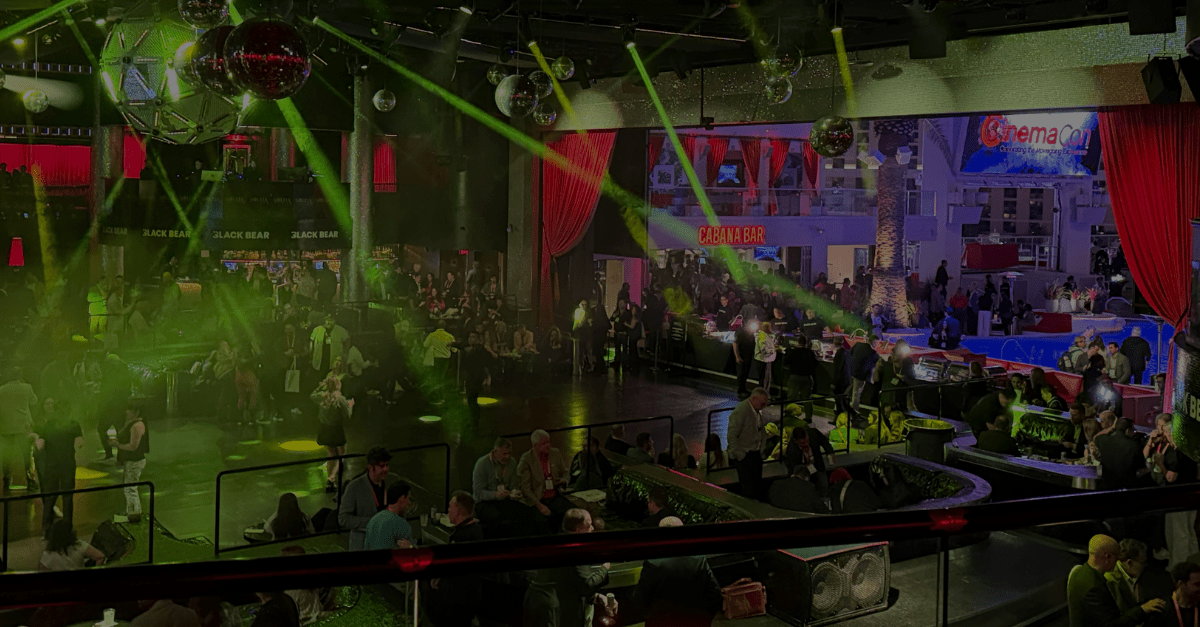
Every April, Hollywood descends on Las Vegas to review upcoming film slates and discuss the state of the industry. This is CinemaCon, of course, the annual theatrical exhibition trade show at Caesars Palace. The splashy event forces studios to face the people who run movie theaters and make the case that their releases are worth showing.
This year, studios pulled out all the stops. Pyrotechnics, movie stars, legendary filmmakers on stage…the works. And they made a stronger case than in years past. Box office is up more than 20% year-over-year. Q1 2026 outperformed the prior two years by 23.4%. Theater owners arrived with tempered optimism for what’s on the horizon.
Outside the bubbly atmosphere, CinemaCon 2026 surfaced structural shifts with direct implications for how content reaches global audiences, and the marketing localization infrastructure that determines whether it lands.
The most consequential business moment wasn’t a trailer or star gracing the stage. It was Paramount’s David Ellison committing in public to a 45-day theatrical window starting immediately. Universal and Disney are also committing in earnest. The locked theatrical window is coming back…let’s see if it holds.
This matters for marketing localization in ways that aren’t immediately obvious. Longer windows mean campaigns run deeper into more territories with more potential reach. Theatrical releases in international markets require locally attuned trailers, metadata, and press materials; not uniform global assets pushed out simultaneously.
The winners will treat international theatrical marketing as finely tuned campaigns designed to reach specific audience segments around the world. International consumers in the glutted attention economy are too sophisticated for anything less.
The Warner Bros.–Paramount merger dominated the subtext of every major CinemaCon presentation, even if it wasn’t often explicitly mentioned. The dual effect proved fascinating: studios presented safer, tentpole-stocked slates while also speaking in passionate defense of theatrical moviegoing. David Ellison’s team even proclaimed, “Long live the movies!”
Regardless of consolidation outcomes, without sustained and tailored global audience engagement, the argument for longer theatrical runs becomes less viable over time. If major studios want a robust release system reaching international theaters worldwide, they’ll need to match that ambition with marketing localization investment across multiple markets.
The volume of video game IP across every studio’s CinemaCon slate was impossible to ignore. Sony: Zelda, Bloodborne, Hell Divers, and Resident Evil. Warner Bros.: Mortal Kombat 2, and Minecraft 2. Universal: Super Mario Galaxy. Paramount: Call of Duty, Sonic 4, Angry Birds 3, and Street Fighter.
This is a structural shift driven by commercial proof. Super Mario Bros. Movie grossed $1.3 billion globally. Minecraft was one of last year’s biggest theatrical events. Super Mario Galaxy is blowing up the box office at the time of this writing. Simply put, video game IP travels. Pre-built fan loyalty and recognized characters translate across languages without the exposition overhead of original stories.
But global reach doesn’t happen automatically. A Resident Evil adaptation that works in the U.S. requires a different approach than one targeting South Korea. Voice casting, cultural references, and marketing tone all need local calibration. The appeal of a genre and/or IP varies from country to country, console to console. In turn, studios investing in gaming titles must have marketing localization infrastructure in place to support the reach these franchises deserve and demand.
Warner Bros. announced the launch of Clockwork, the corporation’s new specialty label, which will be anchored by Sean Baker’s Ti Amo! (his first since Anora swept the 2025 Oscars). This signals a broader trend. A24 and Neon have demonstrated that prestige independent cinema is a sustainable business at scale. Parasite. Anora. Everything Everywhere All at Once. These are not arthouse footnotes, but rather globally distributed, culturally specific films that found audiences in markets their creators never imagined.
That success depends on marketing localization of the highest order. Character-driven, dialogue-dense films require marketers who thoroughly understand not just language and cultural differences, but register, subtext, and emotional tone. A Sean Baker film framed for a cineaste Kyoto audience is a different challenge from localizing a Marvel extravaganza in Tokyo. The specialty label renaissance throws down the gauntlet: for these films, marketing localization must operate at the same level as the creative artists themselves.
Gen Z moviegoing frequency increased 25% year-over-year. They go because it’s an event, not a habit. IMAX sells out in seconds. Letterboxd’s 28 million members represent measurable intent to not just see films, but celebrate them as cultural touchstones. This generation’s relationship with content is global by default. Korean dramas, Japanese anime, Spanish thrillers, and Indian blockbusters…all get consumed alongside Hollywood tentpoles. The subtitle resistance of prior generations has collapsed.
What audiences in this demographic require is quality. Not just accurate dubbing and subtitles, but marketing and experiences that speak to them locally. For studios competing to win this audience internationally, marketing localization is not a line item. It is a competitive variable distinguishing what resonates versus the box office death sentence of being labeled basic and inauthentic.
CinemaCon 2026 confirmed that theatrical is trending upward. The recovery runs on the same forces that make marketing localization essential: longer international windows, richer catalogs, ambitious IP pipelines, and an audience that is younger, more globally literate, and more demanding than any before it. If film slates don’t connect culturally as they move from market to market, the current box office buzz will be a minor blip — rather than the beginning of an overall healthier film industry.
It’s time for the film industry to care and respect filmgoers where they are in the world, not simply expect them to pack theaters with little more than a translated title on the marquee.

Get In Touch
US: +1 720 359 1580
UK: +44 (0)20 7432 7300
600 17th Street, Suite 715S
Denver, Colorado 80202
2nd Floor, Golden Cross House
8 Duncannon Street
London
WC2N 4JF